
The Symbiote Experiment
Abstract. DeFi has hit a wall of fragmentation. Every time a new chain gains traction, liquidity splits across isolated environments and capital efficiency drops. Solvium Labs is experimenting with a different model: Symbiote Isotopes.
Two native tokens, one on Solana (launched via pump.fun) and one on Ethereum/Base (routed through a Uniswap v4 pool with a dynamic-fee hook), are designed to behave as a single entangled asset: one shared market-cap target, one price curve, held together by cross-chain arbitrage and fee synchronisation. This paper sets out the architecture, the equations behind it, and how to watch the experiment on the Solvium Labs dashboard.
1. The Fragmentation Problem
Liquidity follows users, and users are spread across Solana, Ethereum mainnet and a growing list of L2s. The same asset ends up in a dozen shallow pools instead of one deep one. That means wider spreads, more slippage and prices that drift apart between chains.
The usual fix is a wrapped token: lock the asset on one chain and mint an IOU on another. Wrapping brings its own problems:
- Bridge risk. A single lockbox contract holds the backing, and bridges have been some of the largest exploits in crypto.
- Yield decay. Wrapped copies trade at a discount and fragment liquidity further.
- Custodial trust. Many bridges depend on a small multisig or validator set.
The Symbiote model tries to avoid the lockbox entirely.
2. The Core Paradigm: Dual-Chain Isotope Entanglement
Instead of wrapping, the Symbiote model deploys two native assets on two very different execution environments. Neither token is a claim on the other. Each has its own supply, its own pool and its own holders.
What binds them is a shared market-cap target. If Isotope α moves, Isotope β is expected to follow as arbitrageurs close the gap. If volume spikes on Solana, the resulting price gap pulls buying pressure into the EVM pool, and vice versa.
2.1 Execution environments
| Layer | Isotope α · Solana | Isotope β · EVM |
|---|---|---|
| Launch | pump.fun bonding curve, graduating to an AMM pool | Uniswap v4 pool on Ethereum / Base |
| Price discovery | Bonding-curve price Pα | Pool price Pβ, adjusted by hook |
| Fees | Standard venue fees | Dynamic fee set in afterSwap() |
| Messaging | Cross-chain messaging (LayerZero / CCIP class) for price and vault state | |
3. The Isotopes
The Solvium Labs dashboard shows two live specimens. Each has its own page with a live feed, a chart and background notes.
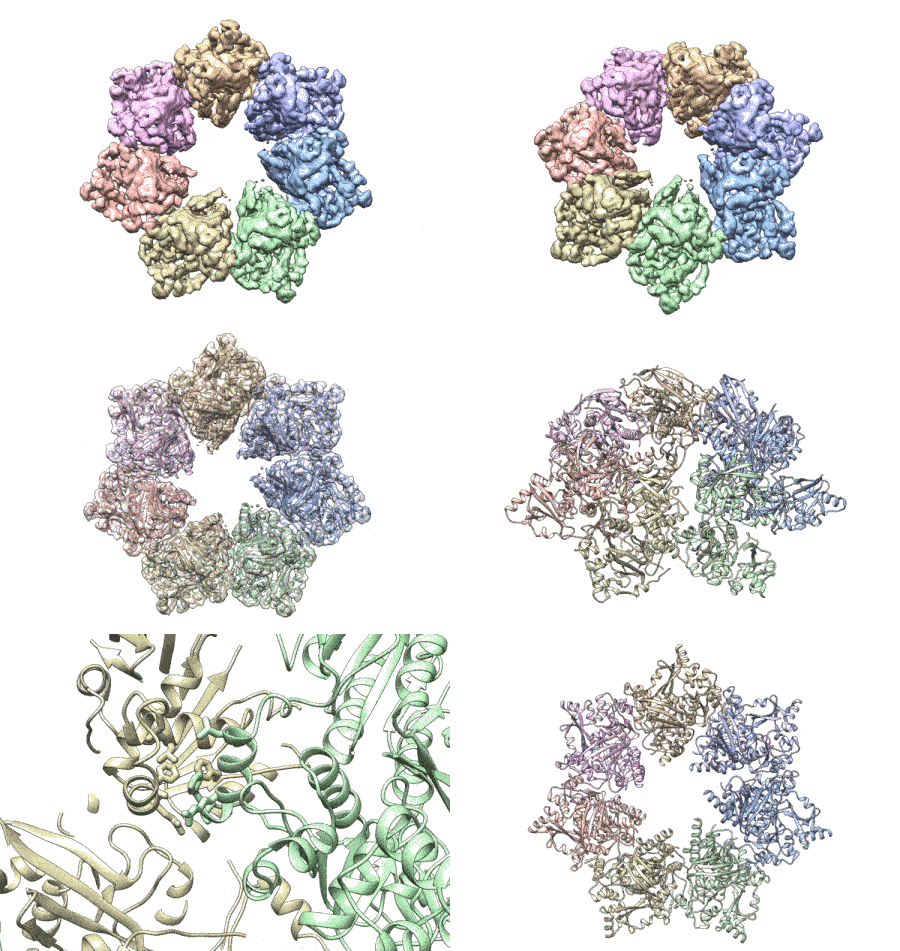
Etritretin
A synthetic retinoid structure, and the first specimen in the chamber.
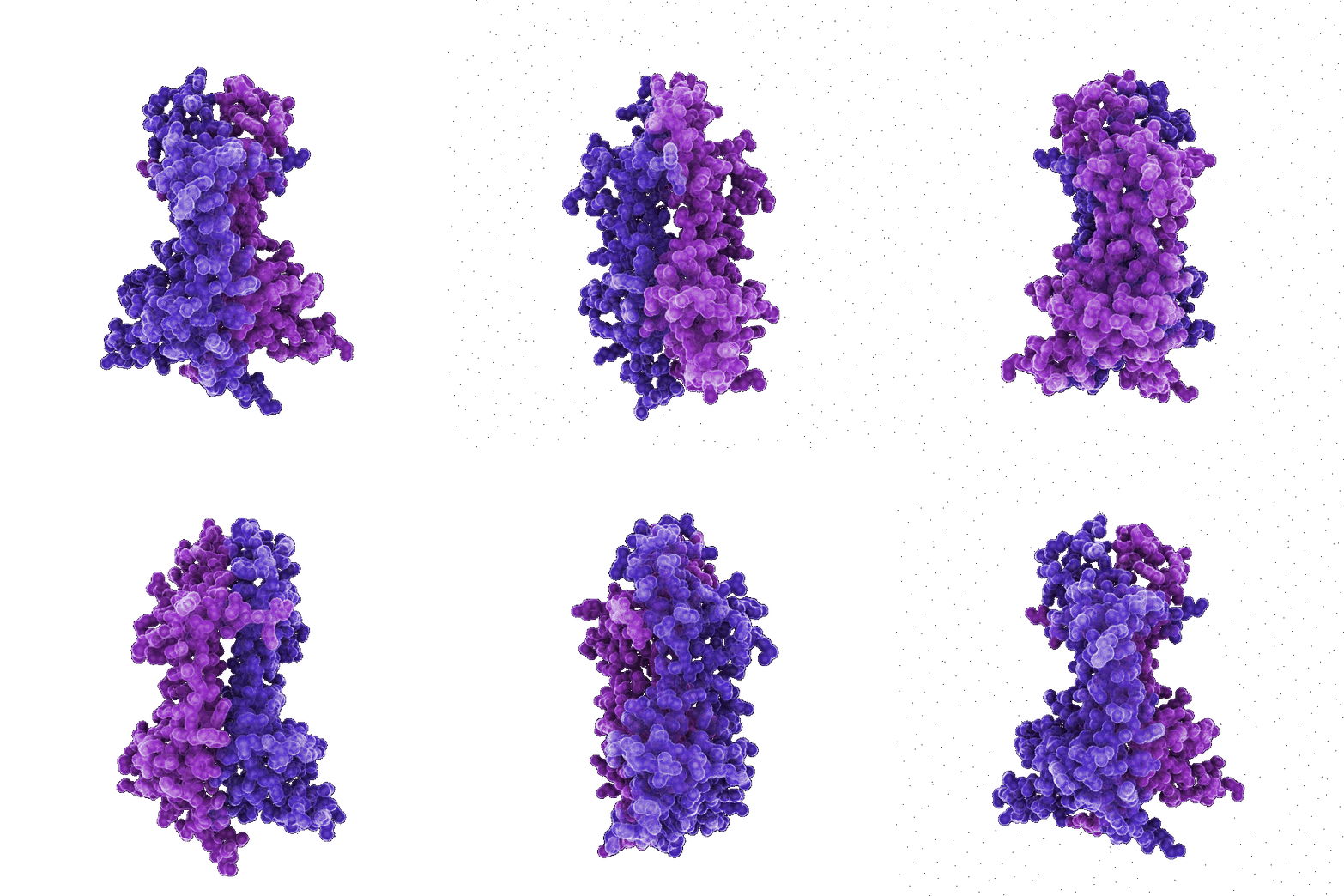
BDNF
Brain-derived neurotrophic factor, the second specimen in the chamber.
Each specimen page is where the entangled pair can be followed: price action, the treated-vs-control chart and the phase countdown.
4. How the Math Works
These are the core equations for price synchronisation, arbitrage bounds and fee routing between Solana and the EVM.
4.1 Market-cap parity & price synchronisation
Isotope α (Iα) on Solana and Isotope β (Iβ) on the EVM share one market-cap target, even though their total supplies (Sα, Sβ) differ:
So the parity price for Isotope β, derived from Isotope α's bonding-curve price, is:
4.2 Cross-chain arbitrage spread & profit bound
Arbitrageurs watch for divergence. Let Sspread be the relative price gap, measured against parity:
Let Tgas be the full cost of executing across both chains: messaging fees (LayerZero/CCIP), EVM swap gas, Solana priority fees and slippage. A rational arbitrage only fires when the gap pays for the trip:
This gives a no-arbitrage band. Prices can drift inside it, but a spread wider than Tgas/Vtrade is an open invitation to bots. The cheaper cross-chain execution gets, the tighter the pair stays.
4.3 Uniswap v4 hook fee routing
When a swap hits the EVM pool, the afterSwap() hook takes a dynamic fee
fsymbiote from the swap amount Aswap. Part of that fee is routed to cross-chain
vault balancing, scaled by how much of the total liquidity already sits on the EVM side:
When the EVM side is thin, most of the fee is kept to deepen it. When it's already deep, more is sent to the other chain. Fees flow toward whichever side needs liquidity, which is what keeps the loop stable.
5. The Uniswap v4 Hook
Uniswap v4 lets a pool attach a hook, a contract that runs custom logic at points in the swap lifecycle. The Symbiote hook is designed to use three of them:
- beforeSwap. Read the latest Solana price and compute the parity spread.
- Dynamic fee. Widen fsymbiote when a swap pushes the pair further from parity, and narrow it when the swap pulls them back together.
- afterSwap. Split the fee between local LPs and the cross-chain balancing vault using the routing function in §4.3.
Swaps that restore parity pay less, and swaps that break it pay more. The hook nudges order flow in the same direction as the arbitrage bots.
6. Observe the Experiment Live
This isn't just a theory paper. The Solvium Labs dashboard is where the experiment is shown, and anyone can open it and follow both isotopes.
| Panel | What to watch |
|---|---|
| FEED | The specimen chamber view, showing the same frame to every viewer at the same moment. |
| CHART | Price action and spread for each isotope, plus the treated-vs-control growth chart. |
| COUNTDOWN | Time until the next phase update, pushed to all viewers in real time. |
| ABOUT | Background on each specimen. |
The lab doors are open. Head to the dashboard, pick a specimen and follow along.
7. Roadmap
| Phase | Focus |
|---|---|
| Phase 1 · Genesis | Launch the dashboard with two live specimens ($TTNPB, $BDNF) and the Solana isotope via pump.fun. |
| Phase 2 · Bonding | Deploy the EVM isotope on a Uniswap v4 pool with the Symbiote dynamic-fee hook. |
| Phase 3 · Entanglement | Add cross-chain messaging for price and vault state, and show the live parity spread on the dashboard. |
| Phase 4 · Mutation | An archive of ended experiments, open data exports and new specimens chosen by the community. |
8. Risks & Disclaimer
Nothing is guaranteed. The two isotopes are separate tokens. Nothing forces their prices together. Parity holds only as long as arbitrageurs find it profitable to trade the spread, and it can break during congestion, low liquidity, messaging outages or extreme volatility.
Hooks, bridges and cross-chain messaging carry smart-contract risk and may contain bugs. Parts of the architecture above are still planned (see the Roadmap) and may change. Dashboard charts and feeds are illustrative and are not financial data.
Solvium Labs is an entertainment and experimental project. Tokens don't represent ownership, revenue share or any claim on Solvium Labs. Nothing here is financial, investment or medical advice.
Crypto assets are highly speculative and you can lose everything you put in. Do your own research.